The program was opened by Dr. Viktória Bódi, Secretary General of BKIK, who emphasized in her welcome speech the importance of Hungarian–Chinese economic relations and the opportunities inherent in strengthening the international competitiveness of Hungarian enterprises. She highlighted that BKIK has been actively supporting the international expansion of Hungarian businesses for many years, and in addition to strengthening European and American partnerships, it places special focus on developing Asian relations.
In the professional section of the program, Attila Bíró, international officer of BKIK, and Péter Babák, Head of the International Relations Office, presented the chamber’s current international projects and the support opportunities available to businesses. This was followed by a presentation by Fruzsina Szohr, Business Development Manager at CECZ Central European Ltd., who introduced the business opportunities offered by the China Brand Fair 2026, one of the most significant Chinese supplier exhibitions in Central Europe. In her presentation, she highlighted that Chinese companies at the fair are not only sellers but also present as buyers, and that small and medium-sized enterprises that do not speak English or Chinese are also welcome, as interpreters are available on-site to assist communication.
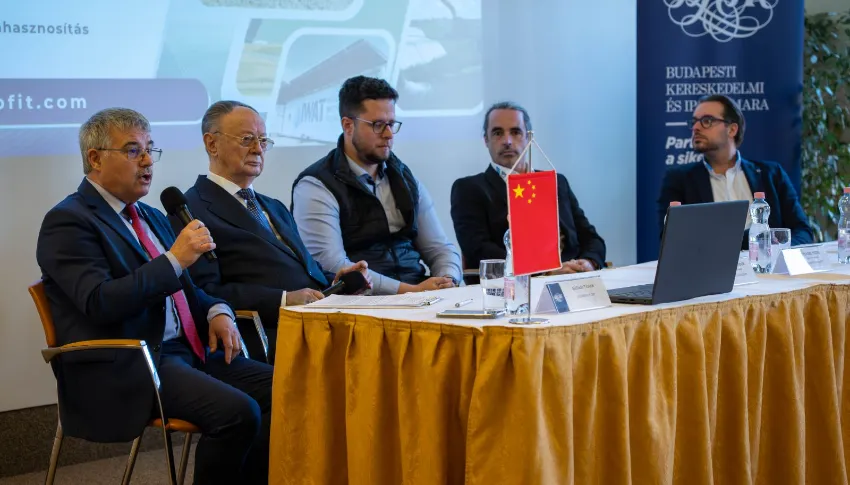
The focus of the event was the roundtable discussion titled “Successful Market Entry and Best Practices.” During the discussion, Tamás Nádasi, Acting Head of the China Regional Committee of the Hungarian Chamber of Commerce and Industry and founding chairman of AQUAPROFIT Plc., along with Sándor Zettwitz, Managing Director of 77 Elektronika Ltd., Péter Gyenese, Managing Director of AGS Engineering Ltd., László Viczián, Business and Product Development Director of EPS-GLOBAL Plc., and Dániel Szablár, owner of Rotovill Plc., shared valuable practical insights.
During the discussion, participants illustrated the key challenges and success factors of entering the Chinese market through practical examples. They agreed that personal relationships, trust-building, and long-term presence play a crucial role in the Chinese business environment, while also emphasizing that market entry requires significant resources. However, with the right strategy and the involvement of local partners and Chinese entrepreneurs, the chances of success can be greatly increased, leading to substantial growth opportunities. It was also noted that during business negotiations, it is particularly important to establish contact with the highest possible level of decision-maker, as Chinese corporate culture is strongly hierarchical, and partners often find it difficult to say no—therefore, situations that would force such responses should be avoided.
Participants also pointed out that the contracting process in China is considerably more complex than what European companies are accustomed to, and the concept of “performance” may be interpreted differently, so it is important to clarify these details at the outset of cooperation. They emphasized that any discrepancies do not necessarily stem from bad intent, but often arise from cultural differences and hierarchical structures. It was further highlighted that emerging issues are best handled through personal, one-on-one discussions, as public criticism may weaken the partner’s status, which can be detrimental to both parties in the long term. Regarding intellectual property protection, it was noted that companies must expect similar solutions to appear on the Chinese market; however, given the size and dynamism of the market, this alone should not justify delaying market entry. Participants emphasized that China is a rapidly learning, knowledge-driven economic environment, where local partners are generally highly motivated to develop, open to cooperation, and strive to build mutually successful business relationships.
Tamás Nádasi highlighted that Hungarian–Chinese economic relations are developing dynamically, and an increasing number of institutional support mechanisms are available to Hungarian businesses for market entry. Company representatives emphasized that the key to success lies in proper preparation, patience, and adaptation to local market characteristics. They added that entering the Chinese market also requires significant financial commitment: it is advisable to have resources that ensure at least one year of sustained presence, including the costs of travel, personal meetings, and business dinners.
The event concluded with a networking session, during which participants were able to continue building connections and holding professional discussions in an informal setting.