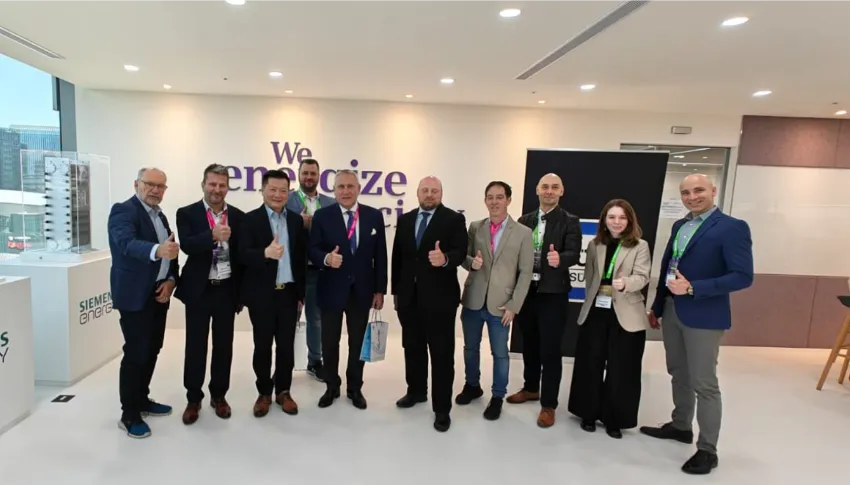
With the cooperation of the Hungarian Chamber of Commerce and Industry (MKIK), the Budapest Chamber of Commerce and Industry (BKIK) organised the participation of the Hungarian business delegation at the Taipei Smart City Summit & Expo in 2025 as well — one of Asia’s most significant smart city development events. We spoke with Péter Babák, Head of BKIK’s International Relations Office, about the visit.
.png)
What background led to BKIK’s Taiwanese mission this year?
BKIK’s network of Taiwanese relations is built on several years of successful cooperation. In 2023, BKIK already organised a delegation to the Taipei Smart City Summit & Expo, where we presented ten Hungarian companies specialising in smart city solutions. One of the most significant achievements was the launch of a cooperation between ASUS and EPS Global Zrt. to jointly develop a smart parking system.
The cooperation has expanded since then: a delegation from CIECA (Chinese International Economic Cooperation Association) visited Budapest, and BKIK signed a cooperation agreement with TCA (Taipei Computer Association), enabling us to once again organise a Hungarian delegation to Taipei in 2025.
How long did preparations take, and how did the process work?
The event was the result of an intensive 4–5-month preparation period. During the planning phase, we held Zoom meetings with TAITRA (Taiwan External Trade Development Council), TCA, and the Hungarian Enterprise Europe Network, which played an important co-organising role together with the Taiwanese and Budapest foreign trade offices. The Hungarian Trade Office in Taipei and TCA provided outstanding support in preparing visits, B2B meetings and forums.
How did BKIK select the companies taken to Taiwan?
We selected companies through an open call based on professional criteria. Key requirements were relevance to the smart city sector, export potential, innovative approaches, and the diversity of the delegation. The companies represented fields such as green infrastructure, AI solutions, transport technologies, logistics, renewable energy, smart parking, waste management, automotive industry and cybersecurity.
What did this year’s visit include?
The central element of the visit was the presence at the 54 m² Hungarian national stand, located in a highly visible, prominent position. The design strongly reflected Hungarian national branding and was suitable for hosting B2B negotiations. In addition to participation at the Smart City Summit & Expo, the programme included the business forum organised by CIECA and TAITRA, a visit to the Institute for Information Industry (III), and an exclusive meeting with representatives of Taiwanese Siemens Energy.
It is important to highlight that thanks to the cooperation between TAITRA and BKIK, almost every member of our delegation succeeded in establishing new business connections.
How do Hungarian participants evaluate the visit afterwards?
Feedback from companies has been exceptionally positive. One company held more than 35 business negotiations, five of which have already led to concrete cooperation. A smart-bench manufacturer received several partnership invitations; an automotive company expects EUR 0.5–1 million in estimated revenue from new partners; and a renewable energy company is negotiating a long-term Asian cooperation worth up to EUR 100 million.
.png)
The promotion of Transport Research Arena 2026 was also successful: based on on-site presentations, 4–6 sponsorship or exhibitor agreements are already in preparation, worth EUR 150,000–200,000.
What lessons did you learn from this year’s mission?
The success of the delegation was driven by several factors: solid preparation, strong institutional cooperation, an attractive and well-positioned stand, and professionally relevant pre-arranged meetings. Another important insight is that the participating companies also started cooperating more closely with one another — strengthening domestic business networks as well.
What are the next steps for Taiwanese cooperation?
The expansion and deepening of relations continues. The next milestone is TAITRA’s return visit to Budapest in May, which will provide another opportunity to launch new Hungarian–Taiwanese collaborations. Thanks to the cooperation agreement with TCA, Hungarian companies can maintain a long-term, sustainable presence on the Taiwanese market.
What upcoming projects is the BKIK International Relations Office working on?
Our next smart-city–focused delegation will travel to Slovenia, where we will study the operation of a live smart urban district and a robotics technology centre. In parallel, preparations are already underway for the Smart City Expo 2025 in Barcelona, where — in line with international trends — we plan to appear with a complex stand incorporating regional and gastronomic elements. Our goal is to showcase not only technological innovation but also Hungary’s unique cultural and regional values.
Thank you for the interview, Péter! We wish you continued success!